How many calories should you eat a day?
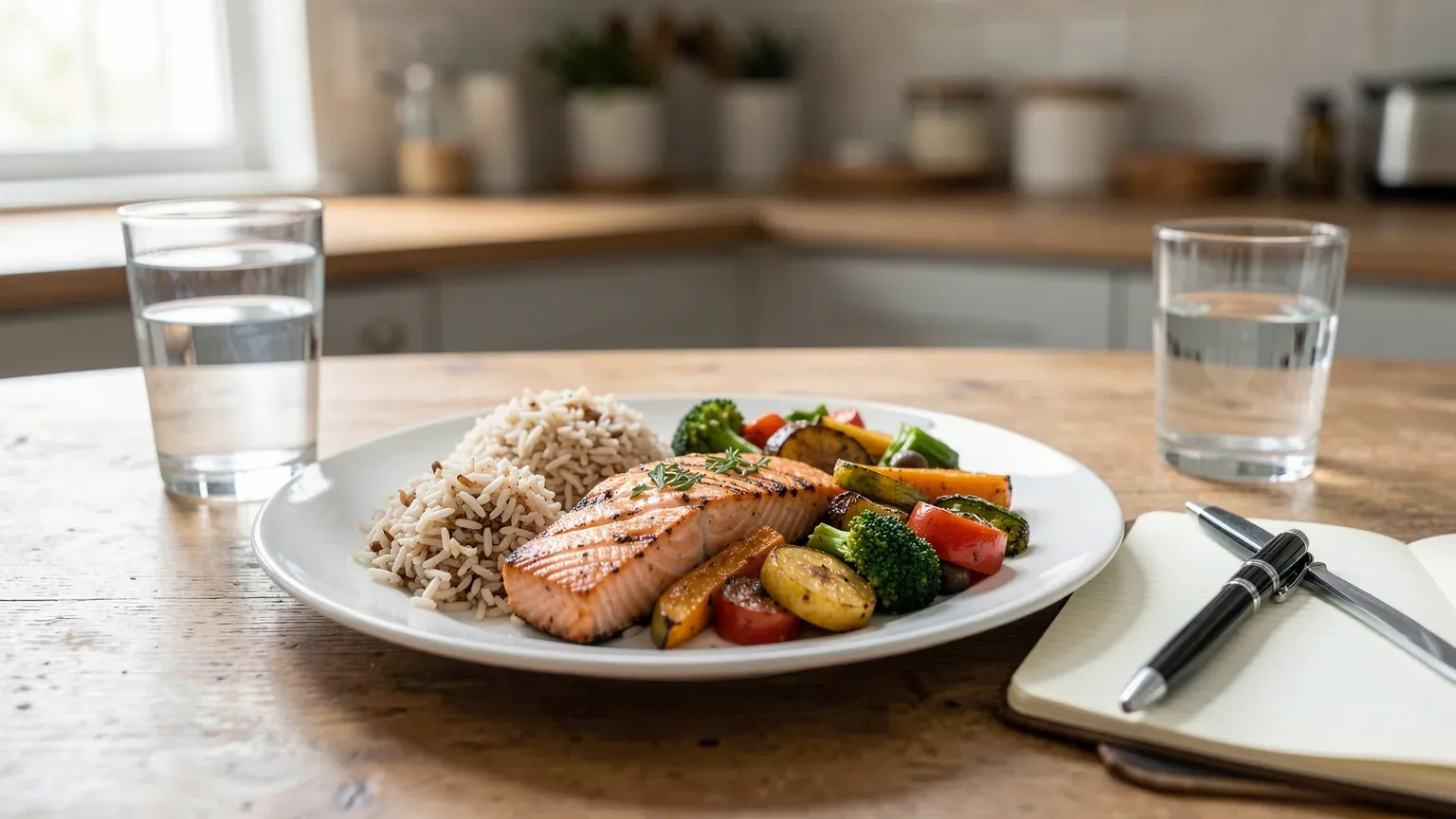
You’ve probably seen “2,000 calories a day” on a food label. It’s a handy round number, but it isn’t yours. How much you need depends on your body and how you move, so the honest answer to “how many calories should I eat?” is: about this much, give or take, and it’s worth checking against how you feel.
Here’s how a daily target is worked out, and why it’s always an estimate.
Where the “average” numbers come from
The NHS says an average man needs about 2,500 kcal a day and an average woman about 2,000 kcal. It adds that your own number can differ with your age, weight, height and how much exercise you do (NHS: understanding calories).
So an average is a starting point. Two people the same age can need quite different amounts.
How a personal target is worked out
Most calculators follow the same three steps.
- Your resting needs (BMR). This is the energy your body uses just to keep going: breathing, circulation, staying warm. A common formula is the Mifflin-St Jeor equation. It was built from measurements of 498 healthy adults and uses your weight, height, age and sex (Mifflin et al., American Journal of Clinical Nutrition, 1990).
- Your activity. Your resting needs are multiplied by a number that grows with how active you are, from a desk-bound week to hard training most days. The result is roughly what you burn in a day, to keep your weight where it is.
- Your goal. Eating about that amount keeps your weight steady. Eating a bit more or less moves it slowly in one direction.
Here’s an example with made-up numbers. A 40-year-old woman who is 165 cm tall and weighs 70 kg has resting needs of about 1,370 kcal by that formula. If she’s lightly active, multiplying by 1.375 gives about 1,880 kcal a day to stay where she is. That’s close to the 2,000 average, but not the same.
Why it’s an estimate
Every step above is an estimate. The formula comes from a group of people, not from you. Your activity is a guess. And the NIH’s Body Weight Planner points out that people often underestimate how much they eat. It says its values are accurate for most people, but will be too high if your metabolism is abnormally low or you’re very sedentary (NIDDK Body Weight Planner).
That’s not a reason to give up on numbers. It’s a reason to treat yours as a starting point:
- Try it for a couple of weeks.
- Notice your energy, hunger and how your weight is trending.
- Adjust a little, and don’t expect precision.
What it looks like in Nutramigo
Nutramigo uses the same approach. To set a personal target, Amigo, the assistant, asks about your sex, age, height, weight and activity, and works out a daily calorie target with the Mifflin-St Jeor equation. The calculation is plain code, not a guess from a chatbot.
If your goal is to lose weight, the target is about 15% (gentle) or 20% (steady) below what you burn. The cut is capped, and it stops at a floor (1,200 kcal for women, 1,500 for men, 1,350 if sex isn’t given, or your resting needs if those are higher). If your maintenance is already at or under that floor, there’s no cut. Nutramigo also doesn’t cut calories at all for anyone under 18, in the underweight range, pregnant or breastfeeding, or with a history of disordered eating.
If you’d rather not share your body details, “just make me a plan” starts at 2,000 kcal and says clearly that it’s an estimate. You can add your details later for a personal number.
Once you have a target, you can see your day against it by logging meals. The numbers there are estimates too. More questions are answered in the FAQ.
When to talk to a professional
A calorie target is general information, not medical advice. If you have a health condition, are pregnant or breastfeeding, have a history of disordered eating, are underweight, or are planning food for a child or teenager, talk to your doctor or a registered dietitian before you set a number. They can look at your whole picture, and a calculator can’t.
The short version
- There’s no single right number: “2,000” is an average, not a rule.
- A personal target comes from your body, your activity and your goal.
- Every step is an estimate, so start with the number and adjust it slowly.
- Check it against how you feel, not only against the math.